What a custom Vinewood sign costs
A typical eight-letter sign is around nine small drawables and one texture dictionary of a few hundred kilobytes, with no script and no per-frame work. The only setting worth thinking about is draw distance.
Server owners ask this before they ask anything else, and the honest answer is that a sign is one of the cheapest things you can add to a server — provided the animation is in the map rather than in a script. Here is what it actually consists of.
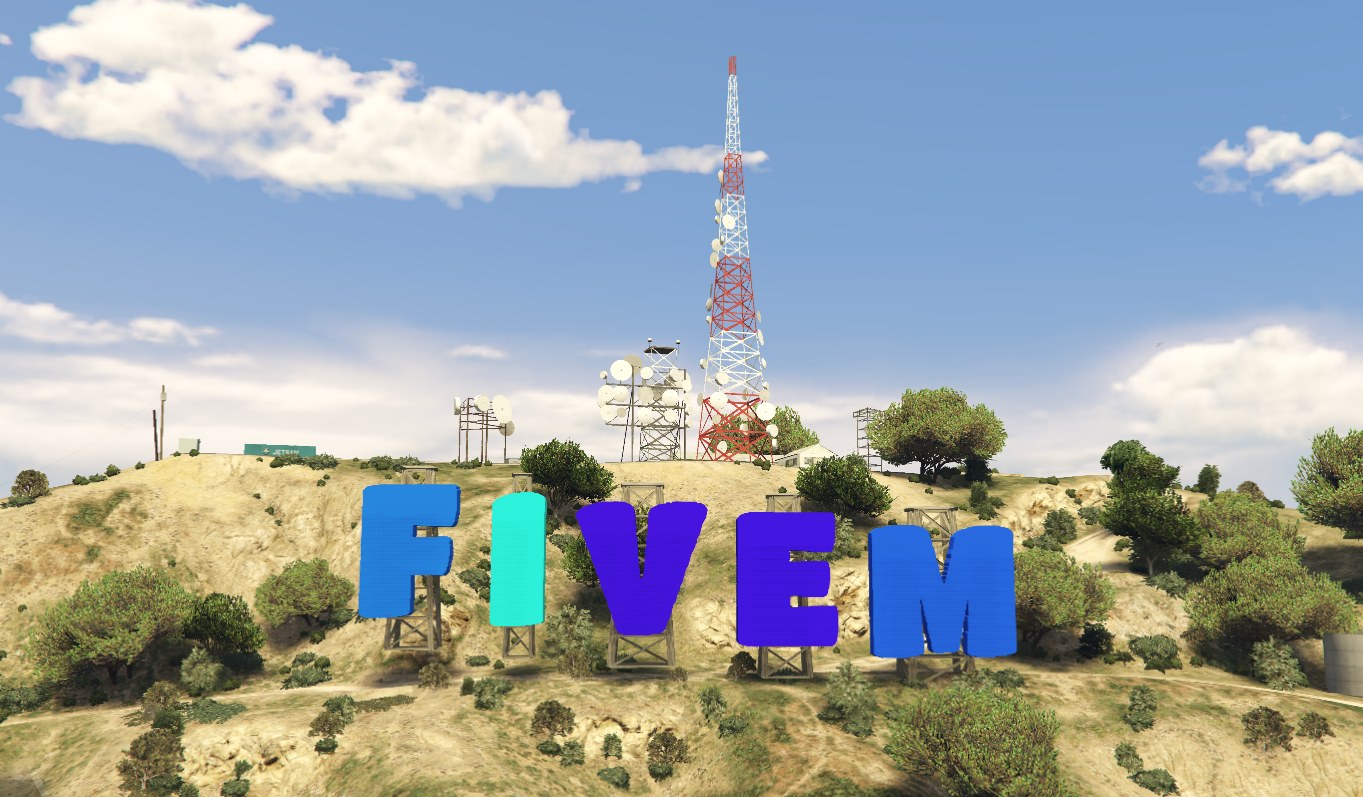
#The numbers
A typical eight-letter sign is nine small drawables — one per letter plus the frame — and one texture dictionary of a few hundred kilobytes. There is no NUI, no script and no per-frame work, so the only ongoing cost is drawing a handful of objects you can already see.
For comparison: a single add-on vehicle with a livery is routinely ten to thirty times the download and considerably more geometry. If your server streams even one custom car, the sign is noise.
| Component | Typical size | Ongoing cost |
|---|---|---|
| Drawables (.ydr) | 8–12 files, small | Drawn when in view |
| Texture dictionary (.ytd) | A few hundred KB | Streaming memory only |
| Clip dictionary (.ycd) | A few KB | None — engine-side playback |
| Type definitions + placement | A few KB | None after load |
| Script | None | None |
#Draw distance is the real lever
The sign is built with a long draw distance on purpose. Twelve kilometres means it is drawn from across the map, which is the entire point of putting your name on a hill — but it is also the one setting that can show up in a profiler if everything else on your server is set the same way.
A handful of long-distance objects is fine. A hundred of them, because somebody set every prop in a custom map pack to the same value, is how a server ends up rendering half the city from the airport. The sign is not the problem there; the pattern is.
#Where the cost is not
There is no thread. Nothing appears in your resource monitor, because there is no resource doing work — the folder contains no Lua at all. A sign cannot cause a hitch warning, cannot leak, and cannot be the reason a restart takes longer.
There is also no per-player cost. Twenty people looking at the hillside cost the same as one, because the animation is a property of the asset rather than something each client computes.
#Streaming memory
Streaming memory is the budget worth watching on a busy server, and a sign uses a small, fixed amount of it. The texture is a narrow colour strip rather than a large bitmap, and the drawables are simple extruded shapes with few polygons.
If you are close to the streaming ceiling already, the culprit is almost certainly vehicles, clothing or an MLO pack — the texture budget guide covers how to find out which.
Questions
Will a custom Vinewood sign cause lag?
Does the animation cost more than a static sign?
How much does it add to the client download?
Can I change the draw distance after buying?
Ready to pick a map?
Twelve themes on three base map styles, $8 each, instant download.
Relevant to what you just read
Look it up while you work
The reference tables this guide leans on, free and without an account.
- All 921 vehicle spawn namesEvery vanilla model with a picture, its display name, its class and the hash CreateVehicle takes.
- The map modding glossary38 terms — file formats, radar parts, framework words — each with a one-line answer first.
- The same tables as JSON and CSVFree downloads, CORS open, no account and no API key — ship the list inside your own resource instead of scraping a page.